Friday the 13th. I posted "Just realised it's Friday the 13th 👀 👀 👀" on Threads.
717 views. 1 like.
My baseline engagement sits between 4-16%. Best posts hit 13-16%. Industry average on Threads is 3-5%. So either my content suddenly became terrible overnight, or something else was going on.
I didn't want to guess. I wanted to know.
The script
I built something to pull 30 days of Threads metrics via the API. Every post, every view, every like, repost, and reply. It calculates engagement rate per post, works out the median as a baseline, then flags anything with less than half the baseline engagement and more than 100 views.
Simple logic. If your content is being shown to people but nobody's interacting with it at a rate that's statistically consistent with the rest of your output, something is intervening between the distribution and the engagement.
Three posts got flagged.
What the numbers showed
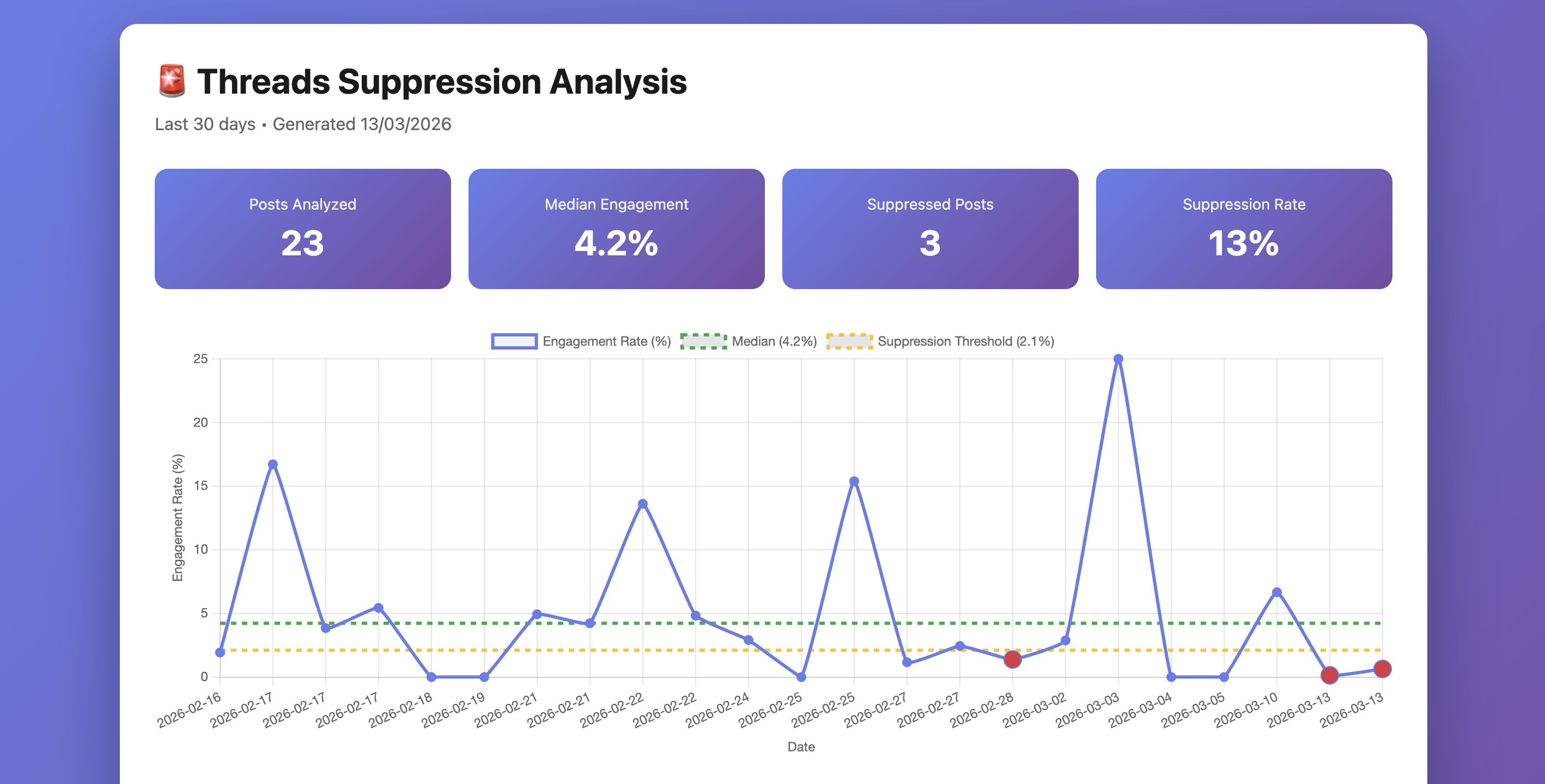
30-day median engagement rate. 4.23%.
The Friday 13th post. 717 views, 1 engagement. 0.14%. That's 30 times below baseline.
A post about Atlassian layoffs. 310 views, 2 engagements. 0.65%.
A post about the Starmer response to the Iran strikes. 17,285 views, 239 engagements. 1.38%.
Same pattern across all three. High distribution, almost no interaction. Meta showed the posts. People saw them. But the engagement was suppressed to a level that's not statistically plausible given the rest of my data.
The Starmer post is the most revealing. Seventeen thousand views. That's not a post Meta buried. They distributed it widely and then throttled the engagement layer. You can see the post. You just can't interact with it the way you'd normally interact with content.
What the posts have in common
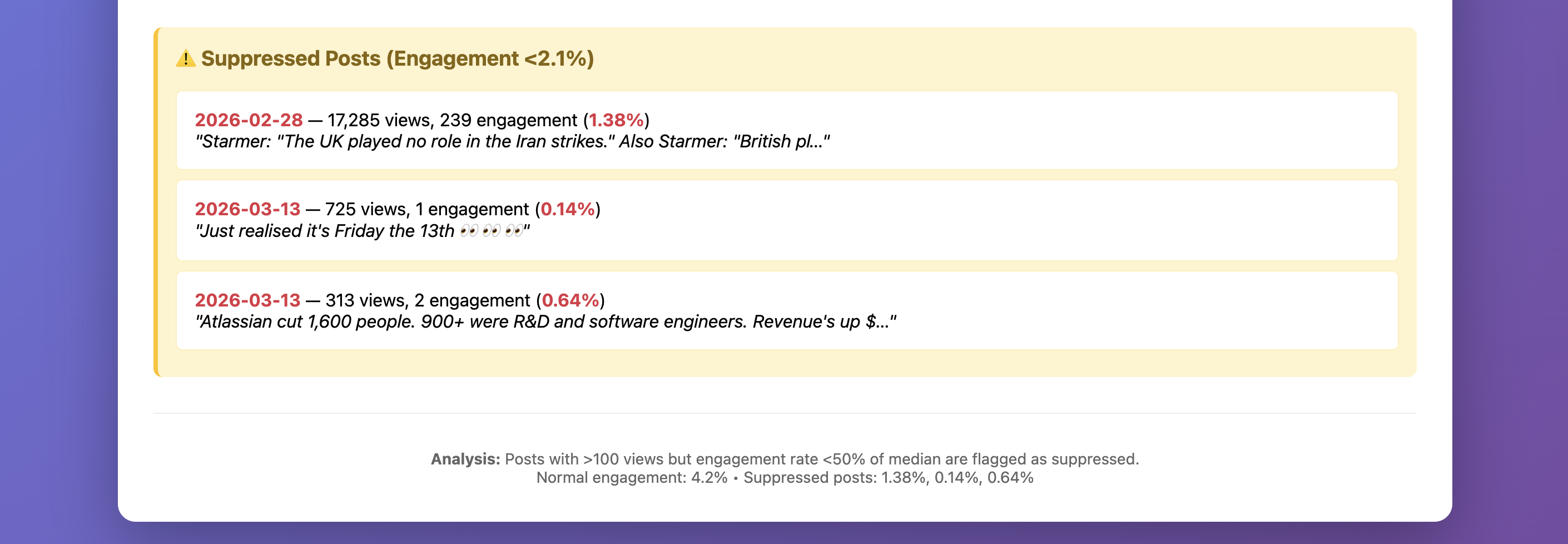
Politically sensitive topics. The Iran strikes, UK government involvement, layoffs at a major tech company. The Friday 13th one is harder to explain, unless "Friday the 13th" trips a sensitivity filter somewhere in the content moderation pipeline. Which wouldn't surprise me at all.
The tool
I'm open-sourcing the script. It pulls your Threads metrics, calculates engagement rates, flags suppressed posts, and generates a dashboard so you can see the pattern for yourself.
If you've ever looked at your numbers and thought "that can't be right," now you can check.
But here's the thing that stays with me. The emotional version of algorithmic suppression is that you start doubting yourself. Your timing, your voice, whether anyone actually cares. The data version is that your content is performing exactly as it should. The platform is just deciding who gets to respond to it.
My engagement dropped from 1,500 interactions per post to fewer than 50. Same content. Same time of day. Different reach.
That's not a bug in your posting strategy. That's a policy choice by Meta.
More in this series: Part 1 (you are here) · Part 2 · Part 3 · Part 4 · Live tracker →